Environment
Why choose recycled parts
To avoid the manufacturing of a new part
By considering the entire life cycle, placing a recycled part back onto the market produces less impact on all environmental aspects than manufacturing a new OEM or generic part.
To prolong the useful life of existing parts
Vehicle parts recycling makes it possible to prolong the life of still functionnal parts, which would otherwise be sent to salvage. It was confirmed that reusing auto parts is more beneficial than scrapping them.
To reduce greenhouse gas
The table below presents how much the carbon footprint of certain parts is reduced for a recycled part, compared to a new part. On the right, the equivalent amount of greenhouse gas is showed, according to the amount produced by a car.
Why are recycled parts more beneficial to society?
To avoid the manufacturing of a new part
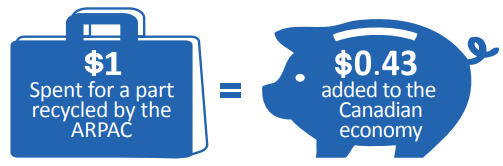
The activities of the ARPAC’s 83 member businesses
generate close to 1 800 direct and indirect jobs and
provide an added value of M to the Canadian
economy.
Risks related to the Chinese parts sector
Original parts from the American supply chain and recycled by ARPAC members generate fewer social risks and more potential benefits than new generic parts originating from the Chinese value chain.

Responsible businesses
ARPAC members follow a code of ethics that makes them accountable to stakeholders. While several ARPAC members have implemented socially responsible practices, there is still room for improvement.

Interested in learning more? Check out the Analyse environnementale et socioéconomique du cycle de vie de la filière québécoise de recyclage de pièces de véhicule (French document). This report, prepared by Quantis and Groupe AGÉCO for ARPAC, contains a lot of information on auto recycling in Quebec and its impact on the environment.
Resources for Recyclers
The following resources target mainly recyclers completing dismantling tasks. Links and documents are grouped by subject: open the corresponding section for more.
Dismantling process for hybrid vehicles [French]
Retrait des interrupteurs au mercure :
Source: Switchout
Capteurs ABS : Liste des véhicules (PDF) – Instructions de retrait (PDF)
Éclairage d’appoint : Liste des véhicules (PDF) – Instructions de retrait (PDF)
Exemples capteurs mercure (PDF)
Guide de retrait, interrupteurs mercure (PDF)
Technique de retrait des interrupteurs et informations – ÉlimiMercure :
Switch Removal Guide – FINAL FRENCH – August 2008.pdf [ 751.5 Ko ] switch examples – FRENCH.pdf [ 1810.37 Ko ] convenience lighting – list of vehicles FRENCH.pdf [ 490.14 Ko ] ABS sensors – removal instructions FRENCH.pdf [ 345.01 Ko ] ABS sensors – list of vehicles FRENCH.pdf [ 266.52 Ko ] Projet pilote sur le recyclage des modules de coussins gonflables frontaux non déployés
Autres ressources :
ABS REMOVAL PROCEDURE REVISED 2 PAGES July 07.pdf [ 95.21 Ko ] ABS VEHICLE LIST REV JULY 2007.pdf [ 33.06 Ko ] Air Bag Crash Sensor Application Chart REv May 2008.pdf [ 42.51 Ko ] Class6-820truck20brochure20v820June202008.pdf [ 97.17 Ko ] Convenience Light Vehilce List Attach A Nov 2007.pdf [ 102.49 Ko ]
La récupération des interrupteurs au mercure :
Articles du magazine Auto prévention – Juin et septembre 2007
Mercure-Auto-p-Juin-Sept-07.pdf [ 790.73 Ko ]
Programme ÉlimiMercure de la Fondation air pur :
SO panel – FINAL FRENCH – August 2008.pdf [ 537.24 Ko ] Switch Out Registration Form – FRENCH FINAL [ 88 Ko ] Switch Removal Guide – FINAL FRENCH – August 2008.pdf [ 751.5 Ko ]
Safe explosion process for airbags [French]
Destruction-Manuelform.pdf [ 1472.13 Ko ] http://www.mddep.gouv.qc.ca/matieres/mat_res/vehicules/guide-bonnes-pratiques-VHU.pdf
Règlement sur les halocarbures (en bref)
Guide de la formation professionnelle
Enviro-compétences vous permet de suivre la formation sur les halocarbures en ligne, au gré de vos disponibilités.
http://www.envirocompetences.org/formations/inscription/formation-environnementale-destinee-aux-travailleurs-utilisant-des-halocarbures/
Information gen.pdf [ 249.16 Ko ] Exigences de qualification.pdf [ 63.77 Ko ] Texte du reglement sur les halocarbures.pdf [ 233 Ko ]
Règlement sur les halocarbures :
[ Editeur_officiel_du_Quebec-Reglement_halocarbures ]Your propane tanks, time bombs?
Recyclez_vos_reservoirs_de_propane.pdf [ French, 1248.87 Ko ]
Since 1983, Auto Prévention helps employees and managers of the auto service industry to take charge of work health and safety, to eliminate accident risks and professional sickness.[French ressources below]
Établissement d’un portrait de risques, secteur du démantèlement de véhicules
Étude menée par l’ÉTS, février 2011
RisquesDemantelementVh-2011.pdf [ 4478.71 Ko ]
La formation chez Auto prévention...
Une toute nouvelle section dédiée aux recycleurs de pièces d’automobiles vient d’être ajoutée au site Internet d’Auto prévention.
Source : Centre patronal de santé et sécurité du travail du Québec
Amiante, modifications réglementaires juin 2013 (PDF)
Informations sur l’amiante dans les bâtiments et la qualité de l’air (site du Centre patronal)
Amiante (French)
Source : Centre patronal de santé et sécurité du travail du Québec
Amiante, modifications réglementaires juin 2013 (PDF)
Informations sur l’amiante dans les bâtiments et la qualité de l’air (site du Centre patronal)
Biological risks (French)
Allergie aux insectes piqueurs (PDF)
Fientes de pigeons (PDF)
Needles : Comment ramasser (PDF) – Lieux de récupération (PDF) – Que faire si piqûre (PDF)
Le Centre patronal de SST vous offre des activités d’information de choix!
Cours et séminaires
Formation sur la conduite de chariots élévateurs
BON DE CONTRÔLE QUALITÉ- Arpac-2017 [ French, 395.4 Ko ]
1 Page de présentation – Banque de formulaires [ 226 Ko ]
1.1 ENGAGEMENT DES TRAVAILLEURS [ 233.51 Ko ]
3 PLAN D’ACTION SST [ 227.37 Ko ]
4 PLAN DES MESURES D’URGENCE [ 239.85 Ko ]
5 ENTRETIEN PRÉVENTIF AIR CLIMATISE [ 233.97 Ko ]
6 ENTRETIEN PRÉVENTIF CHAIN BLOCK [ 236.41 Ko ]
7 ENTRETIEN PRÉVENTIF COMPRESSEUR EXTÉRIEUR [ 231.38 Ko ]
8 ENTRETIEN PRÉVENTIF COMPRESSEUR INTÉRIEUR [ 229.37 Ko ]
9 ENTRETIEN PRÉVENTIF ESSENCE [ 231.05 Ko ]
10 PROCÉDURE TRANSVIDAGE D’ESSENCE [ 235.58 Ko ]
11 ENTRETIEN PRÉVENTIF GUN A AIR [ 228.71 Ko ]
12 ENTRETIEN PRÉVENTIF MACHINE A PNEU [ 229.86 Ko ]
13 ENTRETIEN PRÉVENTIF MEULE [ 261.57 Ko ]
14 ENTRETIEN PRÉVENTIF PETIT LIFT [ 229.31 Ko ]
15 ENTRETIEN PRÉVENTIF POMPE A EAU [ 229.22 Ko ]
16 ENTRETIEN PRÉVENTIF RACK [ 229.38 Ko ]
17 PROCÉDURE POUR UTILISATION DU RACK EXTÉRIEUR [ 232.27 Ko ]
18 ENTRETIEN PRÉVENTIF SCIE A GAZ [ 231.41 Ko ]
19 ENTRETIEN PRÉVENTIF SOUDEUSE [ 228.58 Ko ]
20 ENTRETIEN PREVENTIF (global) [ 217.23 Ko ]
21-22 RÈGLES À RESPECTER CHARIOT-ÉLÉVATEUR [ 355.72 Ko ]
23 TRAVAUX LÉGERS [ 247.14 Ko ]
25 REGISTRE DES TRAVAUX DE RÉCUPÉRATION, D’ENTRETIEN ET DE DÉMANTÈLEMENT [ 133.16 Ko ]
26 CHECK LIST – Listes de controle vérification semi-annuelle [ 227.79 Ko ]
27 CHECK LIST – Listes de controle vérification annuelle [ 221.65 Ko ]
28 CHECK LIST – Listes de controle vérification journalière [ 237.12 Ko ]
29 CHECK LIST – Listes de controle vérification mensuelle [ 221.04 Ko ]
30 CHECK LIST – Listes de controle en fonction des fréquences [ 278.94 Ko ]
31 AFFICHE JE PARS LA FAN [ 256.76 Ko ]
32 FICHE D’ACTIONS SPÉCIFIQUES (FAS) [ 220.07 Ko ]
ARPAC_C.wmv [ French, 177382.86 Ko ]
Règlement no4-Code de déontologie [ French, 93.38 Ko ]
Règlement sur la standardisation des normes [French]
Reglement no6-2011 [ 80.37 Ko ]
Questions-ATAC-SAAQ [ French, 562.33 Ko ]
Link to the OPC website – Office de la protection du consommateur :
Commerçants et recycleurs de véhicules routiers [French]